

The Thomas Condon Lecture honors the legacy of its namesake, a minister, a university teacher and Oregon’s first State Geologist. Thomas Condon used the free public lecture to disseminate scientific knowledge to the general public throughout his career. To honor that legacy, the Oregon Board of Higher Education established the Thomas Condon Lecture in 1944. The generous support of CEOAS and the Research Office allows OSU to bring world-class scientists to campus each year. More about Thomas Condon
Fall 2026 Thomas Condon Lecture
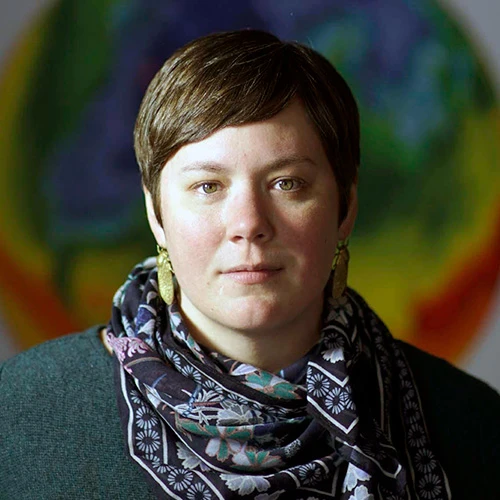
Thursday, November 12
Lecture begin promptly at 6 p.m
Reception beings at 5 p.m.
Location: LaSells Stewart Center and Zoom
Title: Thinking in Mammoth Time: What Lost Ecosystems Can Teach Us About Our Living Planet
Speaker: Jacquelyn Gill, Professor of Paleoecology, University of Maine
Talk summary: Twenty thousand years ago, North America was home to mammoths, giant beavers, massive ice sheets, and ecosystems unlike anything found today. This long-lost world is much closer to us than most people realize, and its legacy is still shaping the ecosystems we live in today. By reading clues preserved in ancient pollen, bones, lake mud, and even DNA recovered from frozen feces, scientists can reconstruct these vanished landscapes in astonishing detail, revealing new insights into how ecosystems respond to profound environmental change. In this journey through the Pleistocene, paleoecologist Dr. Jacquelyn Gill reveals how we study these lost worlds and invites us to think in "mammoth time," discovering what the fossil record can teach us about our own changing planet.
Speaker bio: Jacquelyn Gill is a Professor of Paleoecology at the University of Maine, where she directs the BEAST Lab (Biodiversity and Environments Across Space and Time). An ice age ecologist, she uses fossils, ancient DNA, pollen, and other clues preserved in the Earth's natural archives to reconstruct past ecosystems and understand how life responds to environmental change across millennia. Her research has transformed our understanding of the ecological consequences of Ice Age extinctions and has been recognized by the Ecological Society of America and the National Academy of Sciences. A passionate science communicator, she co-created the award-winning climate podcast Warm Regards and is co-host of the forthcoming Earth history podcast Jax & Phoebe Make a Planet.
2026 George Moore Seminar
Friday, November 13 at 12 p.m.
Location: Burt 193
Title: Dietary evidence for mammoths as keystone architects of the mammoth steppe
Speaker: Jacquelyn Gill
Past Condon Lectures
- 2025 - Nick Zentner - Where did the lava flow and how do we know? A geological mystery and treasure hunt
- 2024 - Elizabeth Holley - Minerals for green energy: how geology dictates the social and environmental impacts of mining
- 2023 - Thure Cerling - Ivory, INTERPOL, intrigue: Using chemistry to solve forensic mysteries
- 2022 - Kathy Cashman - What's under a volcano, and how do we know?
- 2021 - Jim O'Connor - The Missoula Floods and the Channeled Scablands
- 2020 - Julia Clarke - The secret lives of dinosaurs
History of the Condon Lectures at Oregon State
George Moore Seminar
The George Moore Seminar is named to honor the career and contributions of Dr. George W. Moore. Dr. Moore spent his career working for the U.S. Geological Survey where he focused on regional tectonic and structural problems. After retirement, he moved to Corvallis, where he volunteered for the Department of Geosciences in a wide variety of capacities. At the time of his death, George was working on a book about the geology of wine in Oregon.
- 2025 - Nick Zentner - Embracing Baja BC from Oregon to Alaska
- 2024 - Tom Benson - The Geology of Lithium Resources and Best Practices in Lithium Exploration
- 2023 - Thure Cerling - Environments of human evolution in Africa: Some isotopic answers to intriguing, improbable, and (at times) impossible questions
- 2022 - Kathy Cashman - Onset and impacts of the c.7700 ybp eruption of Mount Mazama, OR
- 2021 - Jim O'Connor - Eroding Cascadia—Sediment and solute transport and landscape denudation in western Oregon and northwestern California
- 2020 - Julia Clarke - Voices from the past: How we approach estimation of acoustic characteristics of extinct animals
Note that the Moore lecture has had the same person as the lecturer since its inception in 2008, except for 2024, when a person other than the Condon Lecturer gave the presentation.