

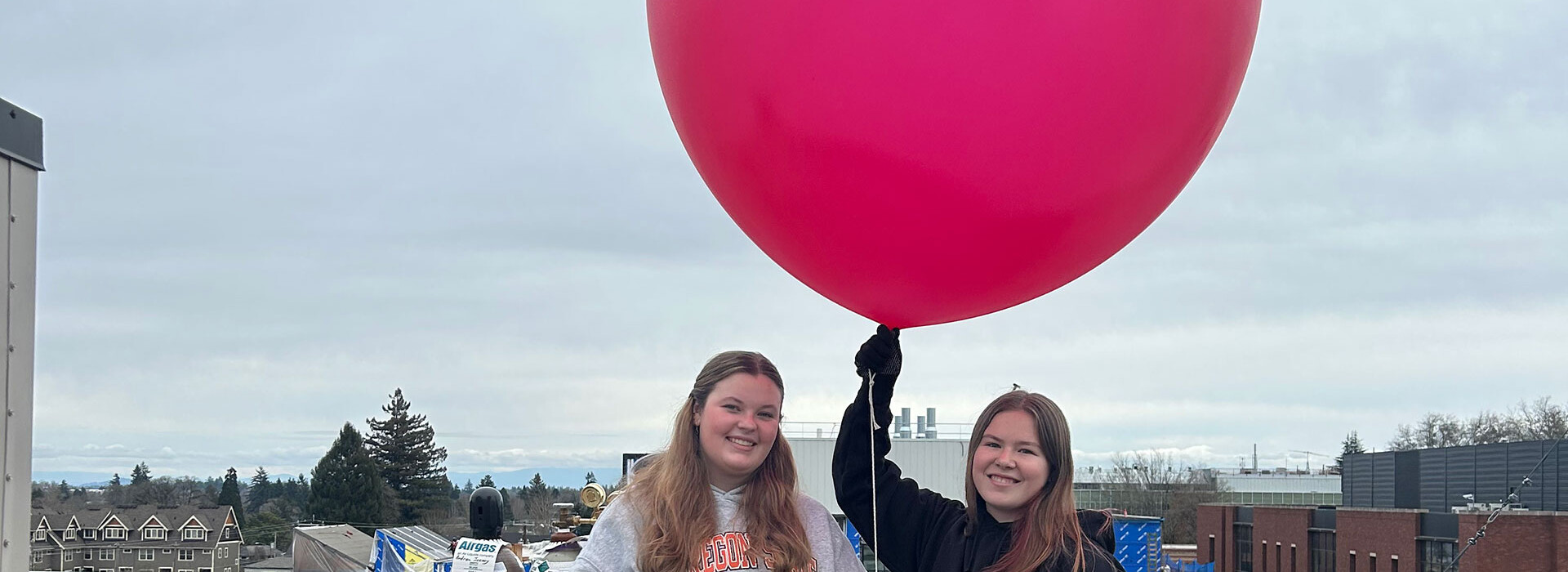
Senior Paige Heinemann takes on climate research, water polo and Greek life
Climate science major Paige Heinemann forecasts a very busy senior year. She’s on track to graduate with all the National Weather Service requirements for a career in meteorology – without needing to tack on a master’s degree.
Her academic schedule is rigorous. This term, Paige’s course load includes differential equations and graduate level atmospheric science, courses not required for the climate science degree program but necessary for NWS.
Beyond the classroom, Paige serves as president of Oregon State's club water polo team and is active in Kappa Delta, balancing leadership responsibilities alongside demanding coursework, research experiences and career preparation.
Why study climate science?
Paige didn’t always know that she wanted to study climate science. But on a plane ride home from a college visit during her senior year of high school, she found herself looking out the window, talking about the clouds with her dad.
“The clouds looked cool! And he made a joke like, ‘you love the weather app, you should just study that.”
After looking into it, she realized that was exactly what she wanted to do as a career. Oregon State University has a dedicated undergraduate program in climate science, so she applied.
Growing up outside of Seattle as a Washington State fan meant that UW was never on the table. Realizing, “there’s actually… a school four hours away that is a great school,” was pivotal for Paige. “And then we visited, and my parents and I just all loved it.”
Gaining research experience
This summer, Paige participated in the Research Experience for Undergraduates program with CEOAS mentor Andrea Jenney, where she spent nine weeks studying how clouds impacted radiation and the overall climate during the last ice age.
She jumped right in to apply classroom coding skills to real-world model simulations, learning there’s not one simple answer. At the same time, she created educational materials for K-12 students, saying, “a lot of the outreach stuff is specifically the way that clouds do both: warm and cool the climate.”
The REU program facilitated group field trips, seminars and lectures outside of individual research projects. They toured lava fields in the Cascades and explored tide pools on the coast. The highlight for Paige was boarding the R/V Pacific Storm for a taste of oceanography research on the Pacific, a field experience she noted wasn’t likely to occur otherwise.
Pursuing climate science opportunities
Paige recognizes that it’s harder to find climate science jobs these days, firmly declaring “I have to be extra dedicated and extra motivated.”
There’s a 100% chance her drive shows up in her work ethic.
The OSU chapter of the American Meteorological Society organizes career-related activities throughout the school year, but she says, “Their meetings have just never worked out for me…I’m in a sorority, and I play sports, and [the meetings] always overlap with something.” So, she puts in the effort to grow her resume independently.
Last spring, Paige and a fellow climate science student, Mia Frolich, did a job shadow at the NWS office in Portland. They reached out on their own and found the staff “were super excited that we were interested” in learning more.
One of the most helpful parts of the job shadow, she found, was hearing firsthand about the application process. She learned about the importance of conveying the meteorology coursework directly on a resume.
Andrea Allan, the climate science program director, has been a valuable resource for navigating Oregon State’s course offerings and NWS requirements. Together, they carefully pieced together Paige’s four-year plan; she even managed to study abroad in Ireland for a semester, taking the geography classes she needed for a minor along with an atmosphere and weather class specific to Europe.
Back in Corvallis, she credits her “very cool” weather forecasting class (CLIM 417) for the chance to apply math and textbook concepts to the real world, motivating her to keep going.
“You had to forecast a week of weather for a city based on all these models and forecast discussions, and then afterward we saw how accurate it was!”
The importance of networking
Paige was sitting in an 8 a.m. Zoom meeting with climate leaders from NOAA, NWS, Scripps, Air Force and others last spring as “they were forecasting for if it was a good time to do a launch” of weather balloons for a research project, when she realized the power of networking.
She had heard about the chance to release weather balloons from a friend who had heard about it in class, and she was in. Because she expressed interest, she was invited to attend the briefing meetings, where she got the behind-the-scenes peek at how a research project comes together.
And remember her climate science mentor Andrea Jenney from the REU program? She was leading Oregon State’s portion of this research effort.
“Oregon state has a lot of really cool opportunities. I feel lucky that it worked out the way that it did.”
Forecasting isn’t just about predicting change. It's about preparing for it. Through research, networking, leadership and a willingness to actively seek out new experiences, Paige has built the skills, connections and confidence to thrive wherever her career takes her. And if her track record is any indication, the forecast ahead looks exceptionally bright.