

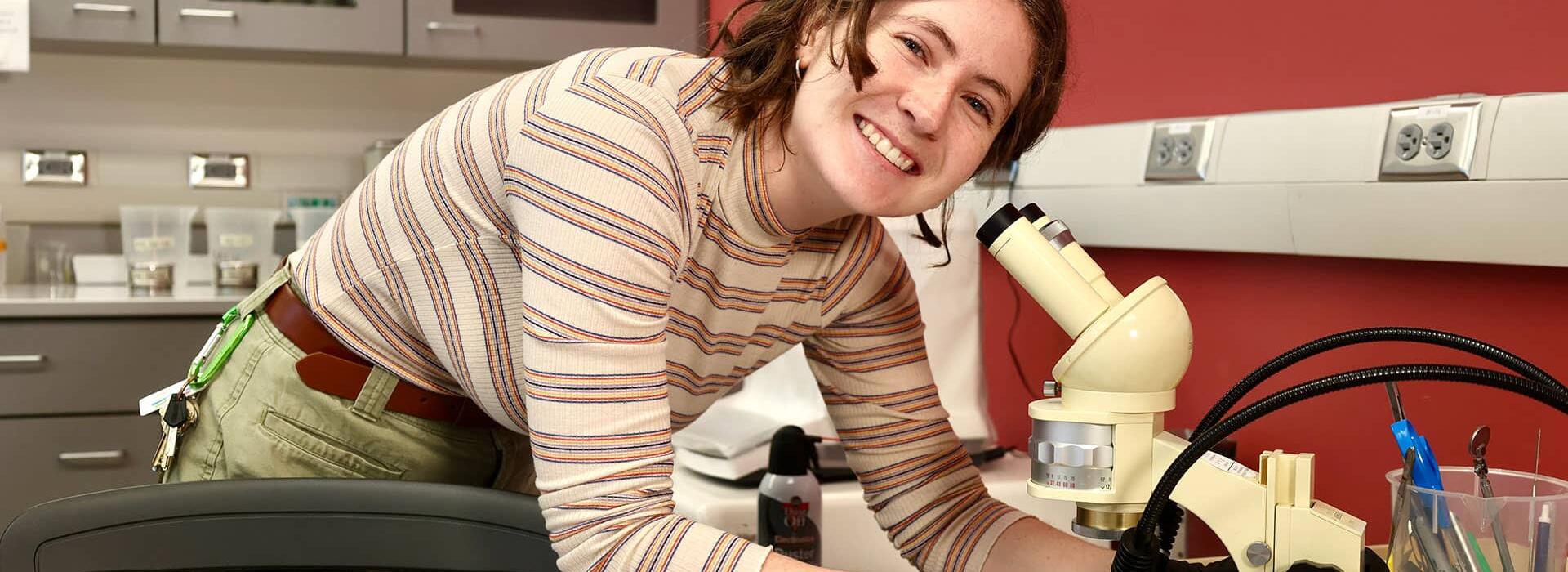
“I've realized that disability and science have so often not been talked about in the same sentence – a lot of disabled individuals don’t know what science could even look like for them,” says first-year geology graduate student Cadence Russell.
Russell has fallen in love with paleoclimate research that uses sediment cores to peer into the planet’s past, but her first co-authored scholarly paper was recently published on a completely different topic: disability studies.
The paper, entitled “Reimagining Self-Determination in Research, Education, and Disability Services and Supports," published in the Journal of Disability Policy Studies, grew out of her work with the Youth Engagement Transition Initiative, or YETI. Just a few years old, YETI is an advocacy organization that engages youth in policy discussions about how those with disabilities transition from the services they receive in K-12 school settings to life beyond age 18.
The journal article focuses on the idea of self-determination, an important concept for the disability rights community but one that Russell and her co-authors thought needed further clarification and contextualization. Russell explains that she and the paper’s other authors are particularly concerned that the definition of such a central concept often comes from non-disabled researchers, rather than from the disabled community itself.
Russell comes to this advocacy via her personal experience with disability: she has dysgraphia, a disorder similar to dyslexia that affects her ability to translate her thoughts into writing. Those with this neurological condition often have trouble with letter formation, handwriting, spelling, and the fine motor coordination needed for putting words on paper. Like many diagnosed with the disorder, she also has attention-deficit/hyperactivity disorder.
“I like to describe it like this: Most people have a bullet train for a brain, trying to get them to places really fast,” she says. “I have an 1800s steam train that runs on coal. I have a certain amount of words in my word bank before I run out of coal, and it gets much harder to move the train forward, to formulate a word or spell it correctly.”
Russell, who grew up near Austin, Texas, was diagnosed with dysgraphia when she was in fourth grade (and ADHD much later), and had reasonable accommodations through a 504 plan throughout most of her K-12 schooling. She first got connected with the disability rights community through a friend she met via Tik Tok, who had been invited to be part of the early days of YETI; she pulled Russell in when she was in high school.
“YETI is part of the National Technical Assistance Center on Transition,” Russell explains. “Transition is the term for going from K through 12 support into life afterwards, so that could be an 18-plus program, that could be college, that could be the workforce, independent living, whatever. Every state has a transition team, and the goal is to improve outcomes for students with disabilities, to help them achieve whatever goals they set for themselves and overcome lack of support, lack of knowledge or belief about what they can do, or help them navigate systems.”
Having a youth council engaging in advocacy on this issue was a game-changer, Russell says. Instead of imposing programs on young people, YETI allows their voices to be heard directly, via advocacy and publicity work.
Russell attended Daemen University in Buffalo, NY, majoring in natural sciences. She is now diving into an exciting project with her advisor, Jeff Beeson, to use sediment cores collected off the coast of Chile to look at methane seep dynamics.
She sees a lot of threads that connect her advocacy activities to science, and thinks that her work in these two realms have informed each other in interesting ways. “If I took a sediment core and then removed all of the background information about where it was collected and just looked at the data in it, that core could tell me things, but I won’t have a complete picture,” she says. “I feel like only looking at the disabled community through the lens of someone who is not disabled themselves is similar – it leaves out critical pieces of information.”
Her advocacy work will continue as her graduate research gets underway, both so she can help advocate for others and to satisfy her own need for community.
“Within the disability community, and within YETI, we have a community where we can rely on each other. We can ask questions. We have each other and that’s really powerful.”
Interested in learning more or accessing disability services?
YETI’s Youth Engagement Now (YEN) website
National Technical Assistance Center on Transition, youth engagement information page
Oregon State University’s Disability Access Services