
As a native of Bend, Oregon, Ashlynn Bowles (Geology ‘25) never took it for granted that she lived in one of the most astounding geological paradises in the country. Growing up among ancient lava flows, massive volcanic craters and towering mountains, she was always in awe of the natural environment, and always had a love for science.
After receiving her geology degree from Oregon State, she felt lucky to be able to head back to the landscapes she loves, when she secured a position as a geoscientist at Mazama Energy, a company developing geothermal energy sources in central Oregon.
Her professional journey started in high school when she and some friends took an introductory geology class at a nearby community college, and it wasn’t long before she was hooked. “Every Thursday we had a field trip-focused class – there’s so much to see around here within a 30-minute drive,” she recalls. One class was not enough, she found, and she ended up taking the whole introductory geology series before she graduated.
What drew her to Oregon State? First things first: She is a third-generation Beaver, and Oregon State has been part of the culture of her family for a long time, from Beaver football games to campus tales. But she was also impressed with the geology program, its rigor and its emphasis on hands-on learning. “It really was an easy choice,” she says.
And that decision really paid off. Bowles loved her time on campus, especially the camaraderie she built with her cohort through all of the traditional OSU geology experiences. “I love both the lab and field aspects of geology, and there were opportunities to do both,” she says, “But I especially loved field camp. You can have labs and classes together, but nothing builds camaraderie like spending a month in the middle of nowhere with people.”
Geology majors at OSU take two field classes: a two-week-long trip to a field camp in Bishop, California as an introduction to field geology and then a culminating four-week excursion to central Oregon before they start their senior year. The shared experience lends itself to bonding in the hallways back on campus.
In the classroom, Bowles especially loved the Earth materials geology series: mineralogy, petrology, petrography. “There’s another level of camaraderie there, too,” she says, “when you’re in the basement of Wilkinson late into the night trying to figure things out together.” She also cites Professor Adam Kent’s class on geochemistry as a favorite, and that class led to another great CEAOS experience for Bowles.
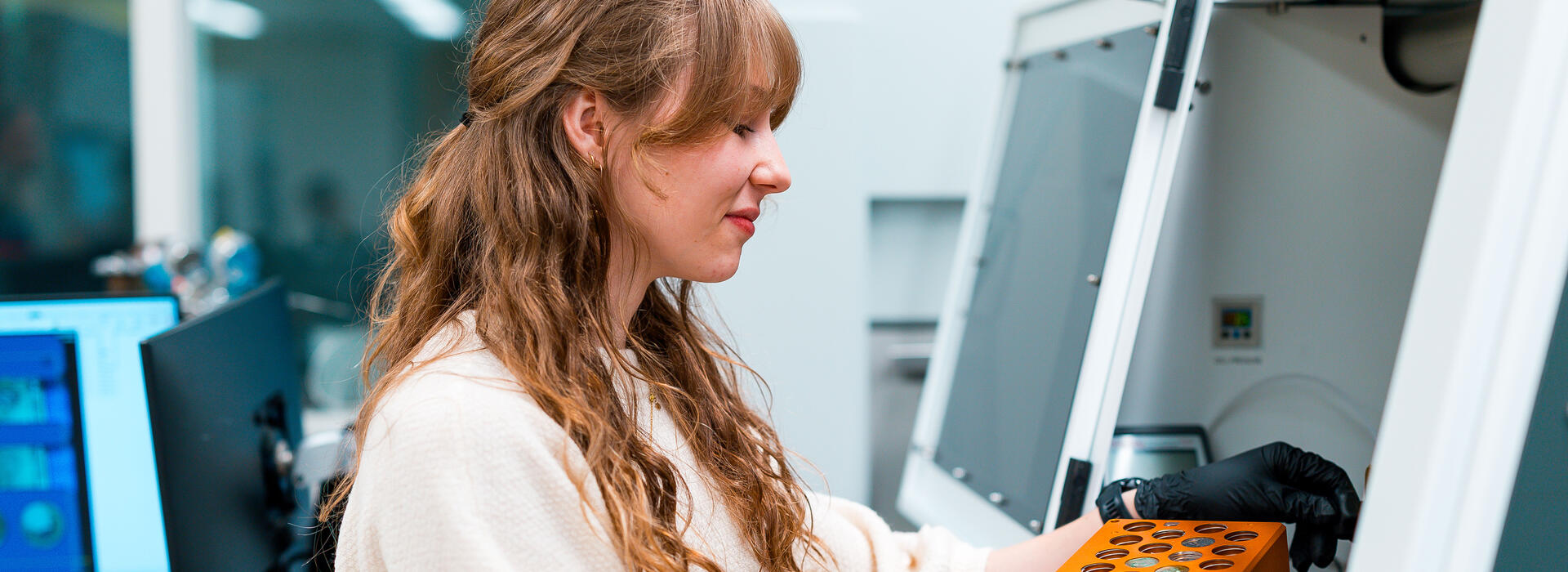
She jumped at an opportunity to conduct independent research in Kent’s lab using geochemical techniques to study plagioclase crystals collected on Mount Hood (which can reveal information about eruption history). This project paid incredible dividends: Not only did Bowles have the opportunity to conduct research and work closely with a mentor she admired, but she learned to use advanced analytical equipment. “That work gave me experience seeing a project through from start to finish and allowed me to dip my toes into research to see if that was something I'd be interested in for the future,” she says. Bowles presented her results in a poster session at the annual Geological Society of America conference.
Her interest in geothermal energy grew when she took an economic geology class with Professor Brian Tattitch. “Students in the class do a project that usually examines a mineral deposit, but she asked specifically if she could focus on geothermal energy,” Tattitch recalls.
As her undergraduate degree came to a close, she reached out to geothermal energy company, Mazama Energy, to ask whether they might have internship opportunities, and Mazama hired her.
Mazama has developed a commercially viable way to extract energy from superhot rocks (that is, indeed, a technical term), starting with a demonstration site at the Newberry caldera in central Oregon. “Geothermal resources usually require a heat source, permeability of the rock, and fluid to be present. At Newberry, there's quite a large heat anomaly, but no permeability or fluid,” she explains. “So Mazama is exploring engineering solutions to access the heat resource, introducing permeability and fluid to the system.”
Bowles is using the geochemical analysis skills she developed at OSU to study the composition of rock samples taken at the site. Understanding the mineral composition of those samples helps to characterize the site, revealing information about how the resource formed, what drilling into the rock there might entail, and what the future of the resource might look like, she explains. She carries out some of this work back at CEOAS in the Keck Collaboratory for Plasma Spectrometry.
“I think the most exciting part has been the fact that this project is so close to where I grew up, and I love getting to see something come to fruition that could really benefit the local community, as well as other areas of Oregon,” she says.
What’s next for Bowles as her internship winds down? She has enjoyed this work so much that she is returning to CEOAS, entering the geology graduate program in the fall of 2026. She’ll earn a master’s degree working with Kent and Tattitch, while continuing to work part-time for Mazama.
“It’s really impressive to see someone like Ashlynn go work for industry, find a lot of success really quickly, and then be interested to come back and learn even more,” says Tattitch.